Some links on this page are affiliate links. If you book or buy through them, we may earn a small commission at no extra cost to you. It never changes what we recommend — every price here is one we would pay ourselves.
Stay in top-class hotels every night, eat in restaurants regularly, shop hard, fly business class, and you can expect weekly costs well beyond $2,160 per person. A visa on arrival, low-cost internal travel, and homestays for under $10.80.
What Things Actually Cost
Belarus is not a country that empties your wallet quickly. The problem is that most of the advice out there describes a version of travel that has nothing to do with how you’ll actually move through the place. So here are numbers, and what they mean.
Some travellers do it the expensive way. Stay in top-class hotels every night, eat in restaurants regularly, shop hard, fly business class, and you can expect weekly costs well beyond $2,160 per person. That’s the ceiling, not the norm. It tells you the top of the market exists. It doesn’t tell you anything useful about the bottom. The top of the market in Minsk means the big Soviet-era hotels on Independence Avenue, the ones with marble lobbies, a doorman who watches the door, and a breakfast buffet that runs the length of a bus. They are not bad places. They are simply priced for people on an expense account, and every purchase inside them — the minibar, the laundry, the airport transfer desk — is priced the same way.
Now the useful part. A visa on arrival, low-cost internal travel, and homestays for under $10.80. That’s the shape of a Belarus trip that doesn’t hurt. The homestay figure is the one that matters most. Under $10.80 a night changes the arithmetic of everything else — food, transport, how long you can stay, whether a bad day ruins the budget or just dents it. In practice, that figure usually means a room in someone’s flat, often in a residential block a couple of metro stops from the centre, with a shared kitchen and a landline phone in the hallway. The host may speak no English at all and communicate through a translation app, or may be a retired teacher who wants to practise. Either way, the kettle works and the door locks, and the difference between paying that and paying three or four times as much for a hotel room is the difference between a two-week trip and a five-week one.
One thing that catches people out: prices in Belarus have historically been quoted in a way that makes the zeros confusing, and the currency has been redenominated more than once. The notes themselves are fine, but the numbers on a menu or a ticket window can look alarming until the conversion settles in your head. Carry small notes. Change is a recurring problem, and a vendor who cannot break a large bill will simply wave the purchase away. Cash still does most of the work outside the big supermarkets and chain cafés, and the ATM that accepts a foreign card is not on every corner, so it pays to take out money when a machine appears rather than when the wallet is empty.
Eating for Almost Nothing
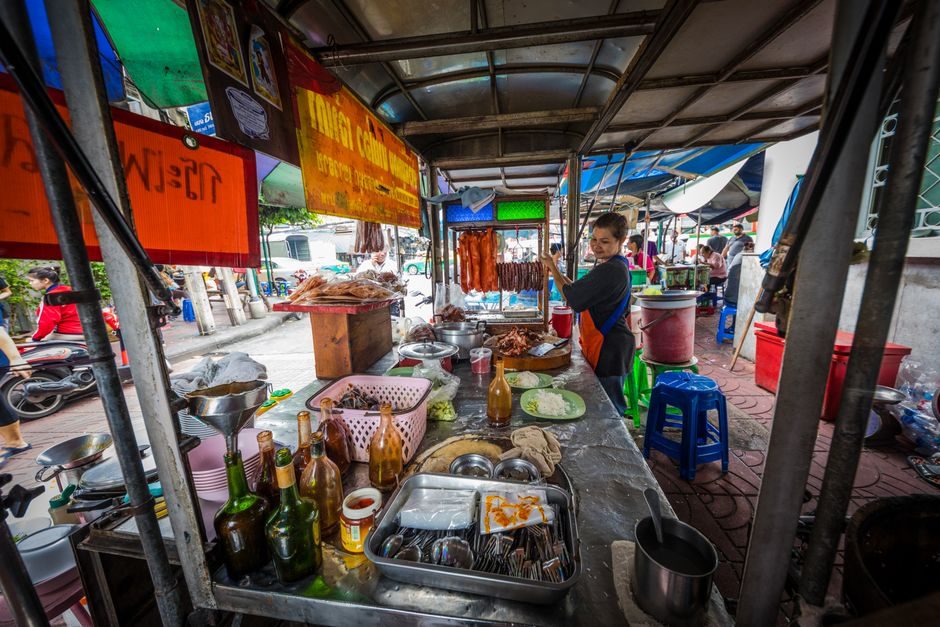
Street food is where the money stays in your pocket. In Vietnam, a common local street food is bot chien — a fried rice flour cake served with sweet soy and vinegar dipping sauce, eggs, and vegetables. It costs around $1.30. That’s a full meal, cooked in front of you, for less than the price of a coffee in most Western cities.
This is the pattern you want to look for. Local food is so much cheaper than Western fare. It’s not a small gap. It’s the difference between a $3 lunch and a $12 one, three times a day, for two weeks. The people who blow their budget aren’t staying in fancier rooms. They’re eating differently. Though there’s a limit — go too many days on the same dish and you’ll crack and pay $10 for a salad. That’s fine. Budget for the crack.
In Belarus the cheap eating is built around the canteen rather than the street stall. The word to look for on a sign is stolovaya — a Soviet-style cafeteria, often in a basement, often with tiled walls and a tray rail, where you point at what you want and pay at the end. The food is plain and filling: soup, a cutlet, mashed potato, a compote. These places fill up at lunch with office workers and pensioners, and the queue moves fast because everyone already knows what they’re doing. Go at noon and copy the person in front. Portions are weighed, so asking for a little more of one thing and less of another is normal and nobody minds. The other reliable cheap option is the supermarket deli counter, where prepared salads and pastries are sold by weight and eaten standing up or on a bench outside — a habit that is entirely normal here and not at all frowned upon.
The trap is the “European” menu. Any restaurant that advertises pizza, pasta and sushi on the same page is charging for the idea of the West, and the bill reflects it. Coffee is the other quiet drain: a chain coffee in a mall costs several times what a glass of tea costs at a canteen, and the tea is often better. Breakfast, if the homestay doesn’t include it, is cheapest from a bakery counter — a pastry and a kefir from the dairy shelf, eaten while walking, is the standard local move and costs almost nothing. Tap water is generally not drunk; bottled water is cheap and sold everywhere, and the kiosks by metro entrances undercut the cafés by a wide margin.
Buses, Trains, and Getting Between Places
Travel by bus across South America is priced by segment, by country, and by how you want to travel. The frequently used routes give you a sense of the range, though those prices are from July 2015 and can vary. The principle holds anywhere: overland transport is cheap if you’re willing to spend the hours.
If you’re crossing borders by air instead, budget $200–$400 for three to four budget flights between countries. That’s the whole allowance, not per flight. It works out to roughly $50–$130 per hop, which is why overland travel wins on cost and loses on time. Pick which one you’re short of.
Belarus leans hard on the train, and the train is where the country’s reputation for punctuality actually shows. The elektrichka — the electric suburban train — is the workhorse for short hops, with hard benches, a lot of standing room, and tickets sold at the station window or from a conductor on board. Long-distance trains run overnight with reserved berths in compartments, and a platzkart bunk, the open-plan carriage, is the cheapest way to cover a long distance while also sleeping. Sheets and a towel are handed out by the carriage attendant, who also runs a samovar at the end of the corridor for tea. It is worth knowing that the attendant controls the door at each stop and may lock it early, so be back in the carriage before the announced departure rather than at it. Buy tickets in advance for overnight trains, especially around public holidays, because the cheap berths go first and the queue at the desk is slow.
For anything you would be annoyed to miss, a booked ticket is worth the small effort.
Buses fill the gaps the trains don’t reach, and marshrutkas — fixed-route minibuses — cover the rest, stopping on request and taking cash to the driver. They leave when full, which can mean immediately or in twenty minutes. The seats are cramped and the driving is confident. They are also the fastest way to get to a small town that has no station, and they cost very little. The one thing to watch is that stops are often announced once, in Belarusian or Russian, and not repeated, so it pays to know the name of the stop before boarding and to keep an eye on the route on a map.
Stay Longer, Pay Less
Stay in one city for two to four weeks instead of two to four days. Monthly rates are 30–50% cheaper than nightly rates. That single change does more for a budget than any amount of hunting for cheap meals. A room at $20 a night becomes $10–$14 a night on a monthly rate. Over four weeks, that’s the difference between $560 and roughly $300–$390. You could eat out every day on the savings.
The same logic applies to regions, not just cities. Spain’s daily budget depends wildly on where you are. Barcelona is 30–40% more expensive than Seville or Granada. Madrid sits in between. Andalusia is where your money stretches furthest. Belarus has its own version of this — the capital costs more than everywhere else, and the gap is wider than you’d expect. Base yourself outside the centre, or outside the main city entirely, and the daily number drops fast.
In Minsk, the line to watch is the metro ring. Inside it, rents and café prices climb; a few stops beyond it, in the same concrete apartment blocks that most of the city actually lives in, the same flat goes for noticeably less and the shops are cheaper too. The metro itself is cheap, runs frequently, and the stations are worth a look on their own — the older ones are decorated with marble, mosaics and chandeliers, and the whole system was built as a showcase. A monthly metro card costs far less than the same number of single rides, and the ticket barriers take tokens bought from a cashier window. Outside Minsk, smaller cities such as Grodno, Vitebsk or Mogilev run on a slower clock, with lower prices and fewer places to spend money at all, which is the point. A homestay in one of them for a fortnight costs less than a long weekend in the capital, and the walking is better.
The Safari Trap, and What It Teaches
A seven to ten day mid-range safari on the northern circuit can cost around $486 per day with a local supplier. Seven days at that rate is $3,400. And there’s an extra cost per day on a seven-day safari for increased transport costs: $164 per person per day. Stack those and you’re at $650 a day before you’ve bought anything.
Belarus doesn’t have safaris. It has the same structural problem: certain activities are priced for people who fly business class, and no amount of cheap eating offsets them. When you hit one of those, the honest move is to skip it or shorten it, not to shave $2 off breakfast and pretend you’ve balanced the books.
Restaurant meals at the top end run $80–$120 for things like omakase sushi, Kobe beef, or kaiseki. You can’t budget your way into those on a backpacker’s money. You can decide they’re not the point of the trip.
The Belarusian version of this is anything organised for foreign visitors: guided tours in English, hotel-arranged transfers, theatre tickets bought through a concierge, and the package trips to the big state museums. The same experience is usually available for a fraction if booked directly, at the ticket window, in person, the day before — though the windows often close mid-afternoon and some sell out for weekend slots, so an early start matters more than a clever app. The other trap is currency exchange at the airport or in a hotel lobby, where the rate is worst; the exchange offices on the street and in the metro underpasses post their rates on a board outside and compete with each other, so a two-minute walk routinely gets a better deal. Bring clean, unmarked notes, because a torn or heavily creased bill may be refused outright. None of this is a scam; it is just the ordinary cost of convenience, and the fix is to walk one block and ask.
The Number That Matters
Add it up for Belarus. Under $10.80 a night in a homestay. Around $1.30 for a street meal. A visa on arrival. Low-cost internal travel. Stay three weeks instead of three days and the accommodation line drops by a third to a half.
The expensive version of this country costs over $2,160 a week. The cheap version costs a fraction of that, and the gap isn’t about sacrifice. It’s about which line items you let into the plan.
What makes the cheap version work is not one clever trick but the fact that the everyday
Leave a Reply