Street grilled chicken with onions and mustard, sold after dark, is 3,000 CFA ($4.80) for a whole small bird. One number to hold onto: a good sit-down meal for two with soft drinks in Bamako is around 15,000 CFA ($24).
What Nobody Tells You About Mali
The first thing to sort out is that Mali is not one trip. The country is roughly twice the size of Texas, and the distances between the places people actually want to see are measured in long days of driving. Bamako to Mopti is about 470 miles. Mopti to the Bandiagara Escarpment is another 60 miles of rough road before the walking even starts. Anyone planning a two-week loop through the south needs to accept that two full days of that fortnight will be spent sitting in a vehicle watching acacia scrub go by.
The Money
Mali uses the West African CFA franc, and the peg is fixed: 1,000 CFA is about $1.60 at the rate most travellers get on the ground. That number matters because almost every price you’ll hear quoted is in thousands. A plate of rice and sauce at a basic roadside eatery runs 1,500 to 2,000 CFA, which is $2.40 to $3.20. A grilled fish dinner in Mopti, with a drink, is closer to 5,000 CFA, or $8. A small bottle of water is 300 to 500 CFA, so under a dollar, but you will buy more of them than you think.
The cash problem is real. ATMs exist in Bamako and in a handful of banks in Sikasso and Ségou, and they are unreliable in a way that is hard to plan around: a machine can be out of cash for three days running. Outside the cities, there are essentially no ATMs at all. The practical figure to carry is two to three weeks’ worth of CFA in hand before you leave Bamako. Cards are accepted at the larger hotels in Bamako and almost nowhere else. Budget $35 to $50 a day for a mid-range backpacker’s pace—simple room, three meals, shared transport—and $20 a day if you’re sleeping in village campements and eating what’s cooked.
Tipping is not a fixed percentage. Guides on the Dogon walk expect 2,000 to 5,000 CFA a day ($3.20 to $8), and it’s usually handed over at the end rather than daily.
Getting Around
Bush taxis are the backbone. They leave when full, which means when there are four people in the back of a station wagon designed for three, plus whatever is tied to the roof. Bamako to Ségou, about 150 miles on good tarmac, is 4,000 to 5,000 CFA ($6.40 to $8) and takes three hours once you’re actually moving. Bamako to Mopti is a 10-to-12-hour day and costs around 10,000 CFA ($16). The waiting is the part nobody mentions: a taxi that “leaves at seven” may not fill until ten.
For the Dogon country, the road ends and the walking begins. A licensed guide is required in practice, not by law but because the villages expect it, and the standard rate is 15,000 to 25,000 CFA a day ($24 to $40) for the guide, plus a separate fee for a porter if you’re carrying more than a daypack. Village campements—mud-brick rooms with a mattress on the floor and bucket showers—run 3,000 to 5,000 CFA ($4.80 to $8) a night, and meals are cooked to order for another 2,000 to 3,000 CFA.
A 4×4 with driver for the Mopti–Bandiagara stretch, if you’re splitting it four ways, works out to roughly 60,000 to 80,000 CFA a day for the vehicle, or $24 to $32 per person.
Sleeping and Eating
Bamako has the only real range. A dorm bed in the Hippodrome area is around 5,000 CFA ($8); a clean private room with a fan and shared bathroom is 12,000 to 18,000 CFA ($19 to $29); air conditioning doubles that. Ségou and Mopti sit in the same band. In Ségou, a riverside room is 20,000 CFA ($32) and worth it for the evening breeze off the Niger.
Food is cheap and repetitive in the best way. Rice with peanut sauce, rice with okra sauce, rice with leaf sauce. A street breakfast of millet porridge or fried dough with tea is 500 to 1,000 CFA (under $1.60). Street grilled chicken with onions and mustard, sold after dark, is 3,000 CFA ($4.80) for a whole small bird. Bottled water is everywhere; tap water is not something to drink.
One number to hold onto: a good sit-down meal for two with soft drinks in Bamako is around 15,000 CFA ($24). That’s the top of the range. You can eat for a quarter of it.
The Dogon Escarpment
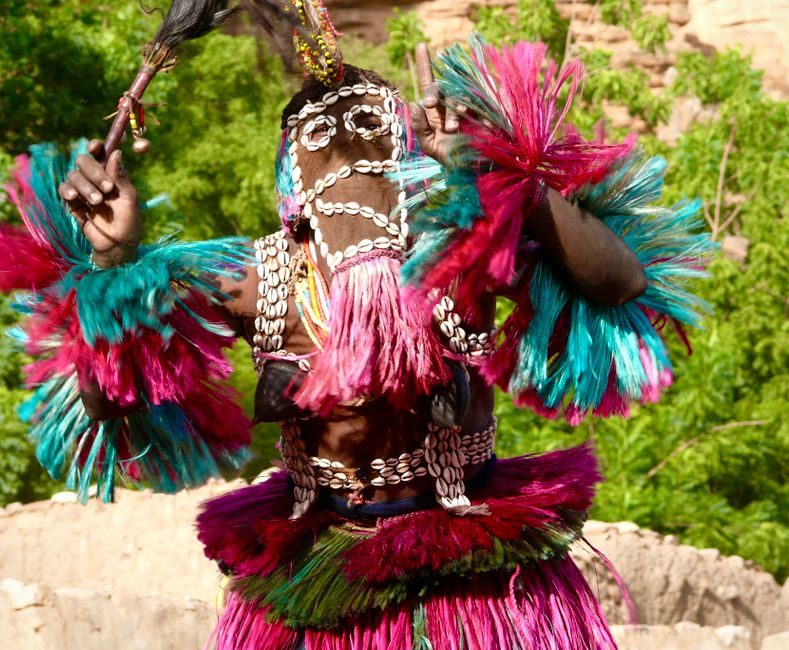
This is the reason most people come, and it costs more than the rest of the country combined. The cliff runs about 90 miles northeast to southwest, and the villages cling to it in a way that photographs flatten and walking does not. Village entry fees are charged per village, typically 1,000 to 2,500 CFA ($1.60 to $4) each, and they add up fast across a five-day walk—budget 15,000 CFA ($24) in total for entry fees alone.
The walking itself is not technical but it is relentless: three to six hours a day, up and down rock staircases, in heat that hits 40°C by early afternoon. Start at 6am. Carry two litres minimum. The campements at the base of the cliff, at villages like Endé and Teli, are basic: a courtyard, a mat, a blanket, a shared latrine. They cost what I said above, and the family cooks whatever there is.
What It Actually Costs
A three-week trip, Bamako in and out, taking in Ségou, Mopti, a five-day Dogon walk and a loop back through Sikasso, lands at roughly $900 to $1,300 per person for everything on the ground—transport, food, lodging, guides, entry fees. That’s the honest range for a backpacker’s pace. The two biggest variables are how many days you spend in a 4×4 versus a bush taxi, and whether you hire a guide for the whole Dogon stretch or share one with other travellers you meet in Mopti. Sharing cuts the guide cost by half or better.
Add the flight, and add the visa, which for most nationalities is issued on arrival for around $110 to $130 depending on length of stay and passport. Carry that in euros or US dollars cash, because the airport counter is not set up for cards.
The heat is the other cost. November to February is the window everyone uses, and it’s the only stretch where a 6am start doesn’t leave you wrung out by ten. March to May pushes past 45°C in the north and the walking gets genuinely dangerous. The rainy season, June to September, turns the dirt roads to soup and closes some of the Dogon tracks entirely.
Leave a Reply