Some links on this page are affiliate links. If you book or buy through them, we may earn a small commission at no extra cost to you. It never changes what we recommend — every price here is one we would pay ourselves.
One two-week self-drive road trip in Namibia used a rented 4×4 SUV that came to $14,871 total. Overland tours in Namibia start at an average of $125 per person per day.
What Three Weeks Costs
Namibia is not a cheap country to travel through, and most people who go find that out in the first week. The question that keeps coming up is simple: what does three weeks of overlanding actually cost? The answer depends almost entirely on whether you camp or sleep indoors. There is no middle path that works especially well, because the country’s geography forces a choice: pay for comfort in the towns, or pay in patience and planning out in the places worth seeing.
Camping changes the arithmetic. One traveller compared three weeks in Namibia to a longer run through South Africa, Namibia, Botswana and Zimbabwe, a 31-day overland camping route that starts in Cape Town and finishes in Johannesburg. The point being made in that comparison was blunt: you can do Namibia for cheaper if you camp or base yourself in the major towns and cities. But the same traveller added a caveat worth repeating. The best parts of Namibia are not those places.
What the towns actually offer is a resupply point. Windhoek and Swakopmund have supermarkets, banks, mechanics and pharmacies, and a night in a guesthouse there resets everything from laundry to sleep. What they do not have is the reason most people flew in. Sossusvlei, the Skeleton Coast, the gravel plains around Spitzkoppe and the waterholes of Etosha are all a long drive from anywhere with a paved main street, and the drive itself is the trip. A typical day behind the wheel runs several hours on gravel, often corrugated, often with a headwind of dust coming through the vents. Nobody describes that part as relaxing, and everybody describes it as the part they remember.
So the savings are real, and so is the trade-off. Camping keeps the daily number down. It also puts you where the country is actually interesting.
The Vehicle Problem
Most visitors do not have their own transport. That single fact reshapes the budget. Without a vehicle you are dependent on tours or shuttles, and that increases costs considerably.
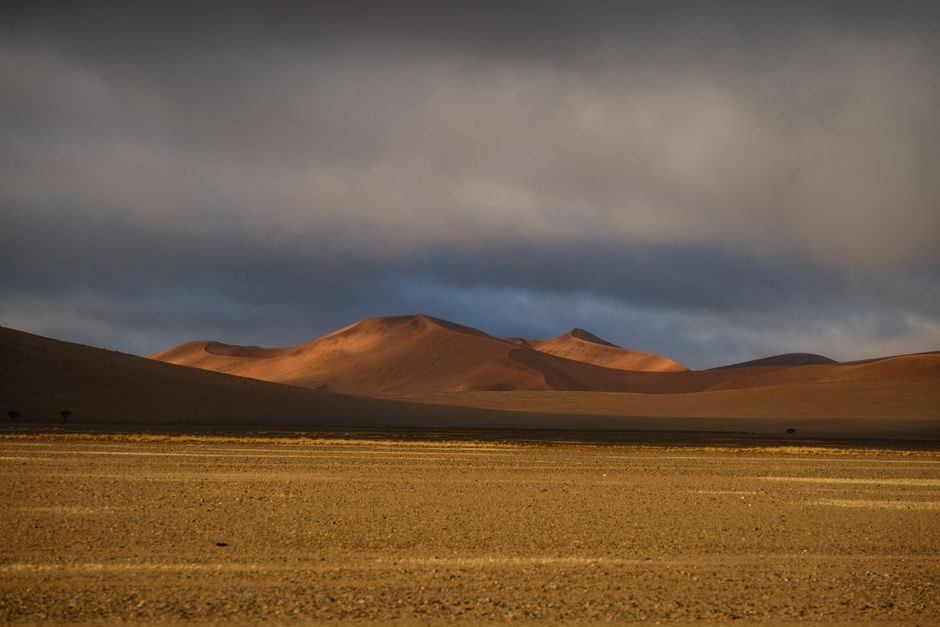
For those who do drive themselves, the rental is the line item that dwarfs everything else. One two-week self-drive road trip in Namibia used a rented 4×4 SUV that came to $14,871 total. That is not a typo and it is not a figure most backpackers can absorb. It is the reason self-drive Namibia is a different trip from overland Namibia, and why the two get compared so often and so badly.
On a slow travel route, your own transport sets the pace.
Part of that number is the vehicle itself and part of it is everything the vehicle drags behind it. A 4×4 with rooftop tents, a fridge and a second spare tyre costs more per day than a sedan, and the sedan will not survive the roads it needs to survive. Gravel roads here are graded but not sealed, and a ordinary tyre puncture on a remote stretch is a half-day event, not a roadside inconvenience. Rentals usually come with a tyre and windscreen exclusion, which means the damage waiver is a separate line on the quote and a separate argument at the counter. Fuel is the other quiet cost: distances between fills are long, stations are sparse on the western routes, and the habit locals keep is topping up whenever a pump appears rather than when the gauge suggests it.
If you cannot bring a vehicle and cannot rent one, the overland tour becomes the practical option. Overland tours in Namibia start at an average of $125 per person per day. That covers all transport within Namibia, activities, camping and most meals. Run it for three weeks and the transport-and-logistics problem is solved, but at a number that has to be planned for.
Tours also do something camping alone does not. They suit solo travellers who want to meet people, and they suit anyone who wants maximum fun with minimal planning effort. That is not a small thing on a route where distances are long and the interesting stops are far apart. The trade-off is pace: a truck moves on a schedule, and the schedule does not wait for a longer look at a waterhole. Groups typically run from a handful of people to a full truck, and the experience depends heavily on who else booked the same departure. The practical advice from people who have done it is to check how many nights are spent in camp versus lodges, because the headline daily rate often assumes camping and the upgrade is priced separately.
Food, Day To Day
Food is where the numbers get gentler. Away from the lodges, breakfast ran around $7 to $10, lunch around $10, and dinner around $15 to $20.
The outlier is inside Etosha National Park. At the lodges there, dinner was charged at almost $20 for what was often a pretty average buffet. It is the most expensive meal most travellers report from a Namibian trip, and it buys you convenience more than cooking. Outside the parks, the same daily pattern holds: a modest breakfast, a simple lunch, a dinner that stays under $20 if you are not eating at a lodge.
Self-catering is where the daily figure drops fastest. Supermarkets in the larger towns carry familiar staples, and a cool box plus a gas burner turns most camp nights into a meal for a fraction of a restaurant bill. The catch is that fresh produce thins out the further west and north you go, and small farm stalls along the route often sell meat, biltong and homemade preserves rather than vegetables. Coffee is a reliable small pleasure and a reliable small expense; the roadside stops that serve it are also where the wifi works, which is worth knowing before counting on connectivity anywhere else. Namibian portions tend to be generous, and a shared plate at lunch is a common way travellers keep the day’s total down without skipping meals.
Add those up across three weeks and food lands somewhere well below the transport figure, which is the opposite of how most people budget a trip.
The One Big Splurge
Some activities are worth naming because they break the pattern. Sandwich Harbour was the biggest splurge on one trip, at $425 per person. That made it by far the most expensive activity of the whole visit. The reason given was straightforward: they did not want to chance driving the giant dunes themselves. The excursion also included kayaking among the seals, which is the kind of thing that does not happen anywhere else on the route.
The day itself runs long. Operators collect early, drive down the coast past the salt pans, and time the dune section to the tide, because the narrow strip between the dunes and the surf is only passable at low water. That is also why the guided version exists at all: vehicles that misjudge it get stuck, and getting unstuck on a falling tide is not a small problem. The reward is a stretch of coastline where the desert runs straight into the Atlantic, with seal colonies, jackals working the shoreline and almost no other traffic. It is a genuinely full day, and the price reflects the vehicle, the permit and the guide rather than any single attraction.
That is the shape of a Namibian budget. A large fixed cost to move around, a moderate daily cost for food, and one or two activities that cost more than a week of dinners. Namibia is a hard sell when it is this expensive. If you have the means, the people who have done it tend to say the same thing: it is worth the splurge.
Who It Suits
The honest summary is that Namibia rewards two kinds of travellers. Those who camp, and those who accept that the transport line will be the biggest number on the spreadsheet. Everyone else lands somewhere in between, paying lodge prices for average buffets and watching the daily total climb.
There is a version of the trip for people who neither camp nor join a truck, and it means picking a base. Staying several nights in Swakopmund and taking day trips outward cuts the transport cost sharply, at the price of never reaching the far north or the deep south. It is a real compromise, not a clever shortcut, and it works best for travellers with more time than money.
The country does not make this easy. It also does not pretend to. What it does is put the good parts far from the towns, which is exactly why the cheap version of the trip and the comfortable version of the trip end up in different places.
Leave a Reply