Some links on this page are affiliate links. If you book or buy through them, we may earn a small commission at no extra cost to you. It never changes what we recommend — every price here is one we would pay ourselves.
Take an 8 to 12 hour sleeper train or night bus instead of a daytime route plus a room. Over a 30-day trip, five overnight legs save you $150 to $250.
What the Numbers Say
A night bus does two jobs. It moves you to the next city, and it removes one night from your accommodation bill. That second job is where the math gets interesting. Take an 8 to 12 hour sleeper train or night bus instead of a daytime route plus a room. Over a 30-day trip, five overnight legs save you $150 to $250. That is not a rounding error. That is a week of street food in Hanoi.
The trade is comfort. Nobody pretends otherwise. Overnight buses and trains reduce both transport and accommodation costs, and they are frequently less comfortable than the alternative. The question is whether the discomfort is worth the money it frees up. For some travelers the answer is obviously yes. For others, it is obviously no, and that is a legitimate position.
Budget travelers can expect to spend $250 to $400 on the ground, excluding expensive tours and flights. That figure covers the basics. It does not cover the decision you make at 11pm about whether to sleep sitting up or pay for a bed.
The Sleeper Advantage
This is for the truly frugal adventurer. You are happy in hostel dorms. You live for incredible street food. You see overnight buses as part of the experience. Your days are free walking tours and self-guided wandering rather than pricey excursions. If that describes you, the overnight leg is not a compromise. It is the plan.
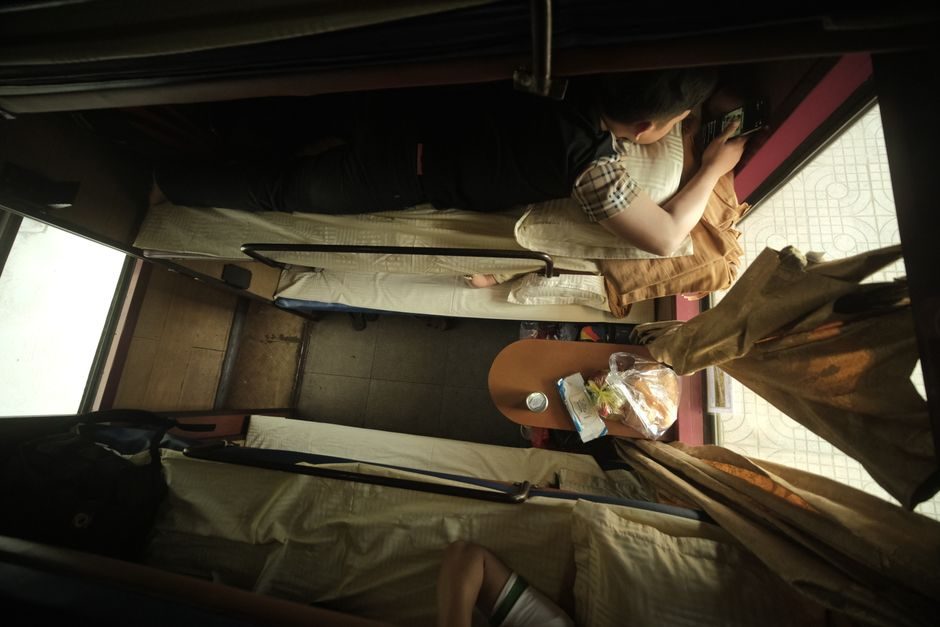
The numbers back it up. India’s rail network publishes sleeper classes that make the whole calculation look silly. AC First Class Sleeper runs $20. AC 2-Tier Sleeper is $15. AC 3-Tier Sleeper is $10. A $10 berth that also cancels a night of lodging is about as efficient as travel spending gets.
Vietnam works similarly. Overnight trains between cities run $15 to $25 for a sleeper berth. A dorm bed in Hanoi or Ho Chi Minh City is $5 to $8. Pho for breakfast costs $1.50. A bia hoi, the fresh draft beer, is $0.30. Hanoi and Ho Chi Minh City are where budget travelers go to feel rich, and the overnight train fits the same logic. You pay $15 to $25, you wake up somewhere new, and you did not pay for a room.
Across the region, a genuine budget traveler spends around $25 to $40 per day. That covers a hostel or cheap guesthouse, street food for every meal, local buses or trains, and entry fees. Vietnam and Cambodia sit at the lower end. Thailand and Malaysia are a little higher but still outstanding value. Five overnight legs on a 30-day trip, at these daily rates, is the difference between a tight budget and a comfortable one.
Where the Money Goes Instead
There is a version of this trip where the night bus is not the point. Some travelers are not overnight bus people. Past a certain age, or past a certain tolerance for arriving wrecked, the calculation flips. Flights and trains that are cheap without sacrificing 24 hours on board a bus start to look reasonable. That is a real cost, and it is not only financial.
The money saved on transport has to go somewhere. A hostel with a shared kitchen lets you buy groceries and cook your own meals. This can cut daily food and drink spending by 40 to 60% compared to a hotel that nudges you toward nearby restaurants and paid services. The night bus and the hostel kitchen are the same strategy in different clothes. Both trade convenience for cash. Both work best when you commit to them rather than treating them as a fallback.

What Region Changes
Quality is not uniform, and price is not either. In the Everest Region, teahouses usually charge $5 to $10 for a room with a shared bathroom during the low season. The rate climbs as you go higher. In Gorak Shep, shared rooms cost $10 to $15. Rooms with en suite bathrooms cost $20 to $40. Altitude sets the price. There is no night bus alternative at 5,000 meters, and the room is the room. Trekking lodges in the Khumbu operate on a simple understanding: the room is cheap because the food is where the margin lives. A dal bhat at altitude can cost more than the bed, and nobody minds, because the alternative is carrying your own rice for a week.
Europe runs on a different scale. Expect $180 to $250 per night for a standard Hilton or Marriott-level room in London or Munich. The exchange rate sits near $1.16 per €1 as of 2026, and the Euro has strengthened slightly, but the value is in specific regions rather than the headline cities. A trip with 2+ weeks and a wish for regional variety, Catalonia, Andalusia, Basque Country, Galicia, each dramatically different, does not need London pricing. The overnight bus is less of a fixture here than in Southeast Asia. Trains do more of the work. The buses that do run overnight, particularly in the Balkans and between the Baltic capitals, tend to be modern coaches with reclining seats and a working USB port, and they often arrive at a station on the edge of town well before dawn, which is its own particular problem when the first tram does not start until after six.
Japan rewards a particular kind of traveler. If you are spending several days in one city, or your route does not follow the Shinkansen lines, individual tickets beat the pass. Four days in Tokyo, five in the Kansai region, and some time in the Alps is a case where buying individual tickets saves money. The overnight bus exists in Japan too, and it is cheaper than the train, but the country is not built around it the way Vietnam and India are. Japanese highway buses are punctual to the minute and the seats are configured in rows of three across rather than four, with a curtain for privacy and a blanket folded on the seat. The trade is that you book online in advance, often in Japanese, and unreserved walk-up seats on popular routes are gone days ahead.
If the schedule is tight, pre-booked tickets remove the wildcard.
Prices have moved since 2012. Anyone who traveled Southeast Asia then and returns now will notice. The structure has not changed. The overnight leg still does two jobs, and the $150 to $250 it saves over a month still spends.
Leave a Reply