Some links on this page are affiliate links. If you book or buy through them, we may earn a small commission at no extra cost to you. It never changes what we recommend — every price here is one we would pay ourselves.
A traveller who tracked every receipt across the islands came out at around $900 per person per day. If you have $900 a day, French Polynesia is straightforward.
French Polynesia does not do cheap. That much is settled before you land. But the number that actually matters is not the one on the postcard. It is the one you pay per day, and the gap between the two is where most budgets fall apart.
Start with the figure nobody wants to print. A traveller who tracked every receipt across the islands came out at around $900 per person per day. That is not a luxury trip. That is a real trip, done properly, with the diving and the boat transfers and the food that does not come out of a packet. If you have $900 a day, French Polynesia is straightforward. If you have $90, it is not impossible, but the trip looks nothing like the brochure.
Part of what drives that number is geography. The territory is the size of Europe with a population smaller than a mid-sized city, and almost everything edible arrives by ship. A container of lettuce that leaves Auckland on a Tuesday can be wilting in a Papeete market stall by the weekend, and the price reflects the voyage, not the vegetable. On the outer islands the supply chain stretches further still, which is why a bag of rice in the Marquesas can cost what a restaurant lunch costs in Tahiti. The locals know this and shop accordingly: they buy flour, tinned corned beef and frozen chicken in bulk on the monthly supply boat, and they plant what they can. Breadfruit, coconut and fresh tuna from a roadside stall are the only genuinely cheap calories in the territory, and visitors who ignore them pay full freight for everything else.
What A Day Actually Costs
The honest budget traveller’s number sits closer to the $30 to $50 per day band that works across the cheapest regions on earth. French Polynesia is not one of those regions. The comparison that stings is Southeast Asia, where a Thai meal lands between ฿80 and ฿150, which is roughly $2.30 to $4.30. You pay 20% more for food on the islands there, and French Polynesia makes that surcharge look like a rounding error. A simple plate in the outer islands is a different order of magnitude entirely.
The mechanics of eating cheaply are worth spelling out, because they are not obvious. The roulottes, the mobile food trucks that set up on the Papeete waterfront in the evening, are the closest thing to a bargain in the capital, and they draw office workers and families in equal measure. A plate of steak frites or chao men there is a fraction of what the same dish costs in a hotel dining room, and the portions are built for people who have been working all day. On the outer islands, the pattern flips: the snack or the pension kitchen is the only option, and it closes when the family decides it closes. Groceries from the local store are expensive but predictable, and a baguette with cheese and a tin of fish eaten on a beach is how a lot of long-stay travellers actually survive. Nothing about it is glamorous, and nobody who has done it pretends otherwise.
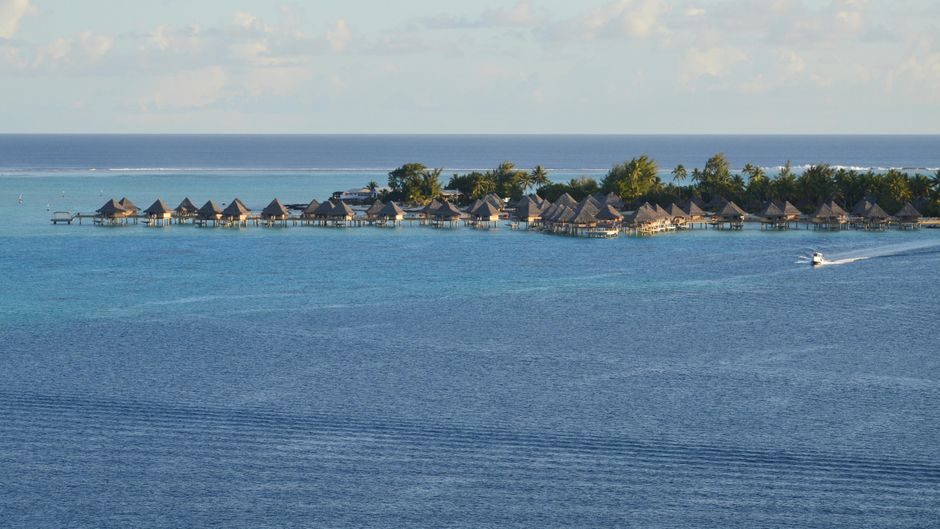
Accommodation follows the same logic. In more off-the-beaten-track locations in the Philippines, a rudimentary beach bungalow goes for under 500PHP, about $10 a night. French Polynesia has no equivalent rung on the ladder. The cheapest beds are still pension beds, and they are not $10.
A pension, for anyone who has not stayed in one, is a family-run guesthouse: a room in someone’s home or a small cluster of bungalows in the yard, breakfast often included, dinner sometimes offered for a set charge, and a shared bathroom more often than not. The family will usually pick you up from the airport or the wharf if you ask, which saves a taxi that would otherwise cost more than the room. What they will not do is run to a schedule. Check-in happens when someone is home, the wifi works when the router feels like it, and the promised hot water may turn out to be solar and lukewarm by evening. None of this is a scam; it is just how the place works. Travellers who arrive expecting hotel service at pension prices are the ones who leave bad reviews.
If you land with no local cash, a pre-paid transfer solves the first hour.
The Cruise Question
One way people cut the per-day pain is by staying on the water. Budget cruises start around $119 to $180 per person for a one-night trip. The jump to mid-range four-star at $200 to $280 is large, and travellers who have done both tend to say the difference is obvious the moment you step aboard. Two-night cruises typically run $330 to $500 mid-range, and $500 and up for luxury. That is a lot for two nights, but it folds in a bed, meals and transport between islands that would otherwise be billed separately. For a short trip, it can be the cheapest way to see three islands without three inter-island flights.
The arithmetic only works if the itinerary is one you would have paid for anyway. A cruise that spends a day anchored off a lagoon you could have reached by ferry is not saving anything; a cruise that moves you between two distant archipelagos is. The catch is that shore time is short and fixed. Passengers get a few hours at each stop, which is enough for a beach and a market and not much else, and the excursions sold on board carry their own mark-up over what the same tour costs if booked ashore. Booking independently is possible but risky, because the ship will not wait. Anyone who has watched a tender pull away from a pier with two empty seats knows how that story ends.
Where The Numbers Break Down
The $900-per-day figure is an average, and averages hide a lot. The same seat on the same plane can cost $18, $55 or $185 depending on when it is bought and how full the cabin is. Costs vary by source-market mix and seasonality in ways that no single midpoint captures cleanly. In the wider Pacific and Asia context, Tet in mid-February, the April 30 holiday week, and the Christmas and New Year peak all push accommodation and tours up by 15% to 30%. French Polynesia runs a similar pattern around its own high season, and the surcharge lands on the two things you cannot skip: beds and boats.
The inter-island flights deserve their own warning, because they are where a carefully built budget quietly dies. Air Tahiti runs the network, and the fares are not published in the simple way most travellers expect. They are banded, they change with demand, and the cheapest seats on a given route are gone long before the departure date. A flight booked months out and a flight booked the week of travel can differ by a factor of several, and the small aircraft that serve the outer islands fill up in high season regardless of price. The practical consequence is that island-hopping has to be planned in advance or abandoned. Turning up at the domestic terminal in Papeete and hoping for a seat is a strategy that works occasionally and fails expensively.
There is also the slow bleed of fees. Mexico’s 2026 tourist fees add $25 to $100 or more to a trip depending on where you go. French Polynesia has its own version of this, and it is worth budgeting for it in advance rather than discovering it at a wharf.
Some of these charges are invisible until the moment they are collected. Inter-island ferries and excursion boats levy port and environmental fees that appear on the ticket, not in the advertised price. Certain islands charge a landing or access fee for visitors arriving by sea. Diving operators add a small charge for the marine park, which goes toward mooring maintenance and, in a few places, toward the cost of keeping the lagoon’s population of sharks and rays protected from fishing. None of it is large on its own. Added across a two-week trip with a lot of water time, it is not nothing, and the honest thing is to treat it as a line item rather than a surprise.
What This Means For A Real Budget
If you are planning a long trip and hoping a house-sitting arrangement will carry the accommodation cost, French Polynesia is a poor candidate. The supply of sits is thin and the demand is not. For a couple travelling a year on something like $45,000, French Polynesia is a two-week stop, not a two-month one. Compare it with Indonesia, where 21 days in Bali came in at $1,834, or $87 a day. That is a real budget trip. French Polynesia is a real trip on a real budget, and the two are not the same thing.
What the comparison really shows is that the islands reward a different kind of planning. A traveller who commits to one island, rents a small house or takes a long pension stay, cooks most meals, and dives or swims from shore rather than paying for boat trips can hold the daily number down in a way that a moving itinerary cannot. That trip is slower and less photogenic. It also costs a third of what the same fortnight costs someone chasing a different island every three days. The money in French Polynesia is spent on movement, and the fastest way to spend less is to stop moving.
The honest version is this: pick your island, pick your season, and decide in advance whether you are doing the cruise or the pension. The $900-a-day traveller and the $90-a-day traveller are both in French Polynesia. They are just not on the same beach.
Leave a Reply