Some links on this page are affiliate links. If you book or buy through them, we may earn a small commission at no extra cost to you. It never changes what we recommend — every price here is one we would pay ourselves.
In San Marcos, on Lake Atitlan, a third of that — roughly $6.50 for the same wash. The commonly reported range for a single load — washed, dried, folded — sits around $2 to $5.
What Laundry Actually Costs
Two places in Guatemala, same country, same bag of clothes. In Antigua, 150 quetzals. That works out to about $19. In San Marcos, on Lake Atitlan, a third of that — roughly $6.50 for the same wash. That gap is the whole lesson. If you are coming off the Acatenango hike with a pack full of filthy layers and you are heading to the lake next, do not hand your bag over in Antigua. Wait. The town two hours away charges a third of the price and you were going there anyway.
It is not always that dramatic, but laundry is one of those costs that quietly eats a budget because you stop noticing it. Two dollars here, four dollars there. The commonly reported range for a single load — washed, dried, folded — sits around $2 to $5. Some places do it for $3 and you will genuinely miss them when you leave. Others charge closer to $19, and at that point you are paying for convenience rather than soap.
The mechanics matter as much as the price. In the cheap places, the routine is almost always the same: a woman with a scale by the door, a plastic bag weighed on a hook, a paper ticket with a number torn in half, one half to you. Drop it in the morning, collect it after lunch or the next day. The clothes come back folded into a tight brick, sealed in plastic, smelling of whatever detergent the shop buys in bulk — usually so perfumed that it takes a day of wearing to fade. Nothing is separated by colour. Nothing is washed in cold unless you say so. If something is delicate, say so before it goes in the bag, in whatever language you can manage, and point at the garment.
What goes wrong is usually time, not soap. The two-hour turnaround quoted at the counter is often a next-day turnaround in practice, and if a shop is doing the washing for three guesthouses at once, “tomorrow morning” can slide into tomorrow evening. The failure mode is standing at a closed shutter on the morning of a bus, bag still wet inside. The fix is unglamorous: hand laundry in the morning, not the evening, and never on the day before a long journey. Same-day service exists in most tourist towns and it costs more, sometimes double, because the shop has to push your bag to the front of the queue. Pay it when you have to. Skip it when you don’t.
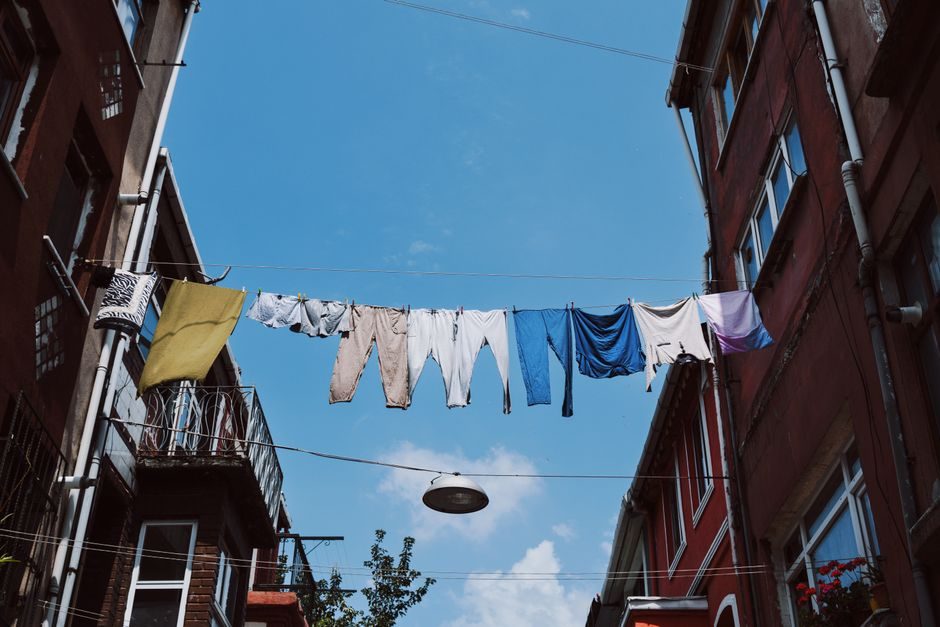
Hostels are the third option and the worst value on paper. A machine in a hostel basement usually takes coins, and the machine is often broken, and the dryer is often a line on the roof. But a line on the roof is free and it works. A travel clothesline and a bar of laundry soap cost less than one hotel wash and last the whole trip. The trade is time and a slightly stiff shirt. For anyone moving slowly, it is the best deal going.
The Yen Problem
There is a ceiling on this. A hotel laundry service in Japan ran almost 10,000 yen for a small batch of shirts, which converts to roughly $67. The service was good. It removed a stain from a skirt that another cleaner had failed to shift. But $67 for laundry is a different category of spending, and it only makes sense when the alternative is carrying wet clothes onto a plane. Most travellers will never touch that number. It is useful mainly as a reminder that “laundry service” means wildly different things depending on whether you are handing a bag to a guesthouse or to a hotel front desk.
The hotel version is worth describing, because the price buys a process rather than a wash. A form is filled in with a count of each item — shirts, socks, underwear, each written on its own line. A staff member recounts the bag in front of you before it leaves the room. It comes back on hangers in paper, or in tissue inside a box, usually within a day, sometimes by the evening if you catch the morning pickup. That is what the markup pays for: the accounting, the presentation, the liability if something is ruined. In a guesthouse, the same shirt goes into a sack with a stranger’s towels and comes back with a story. Both are legitimate. Only one is cheap.
Cheaper markets exist too. In Morocco, a load through a riad or a local laundry runs 30 to 50 dirhams, which is about $3 to $5. Bottled water there costs 5 to 10 dirhams per litre, so $0.50 to $1.00, and tap water is not recommended for drinking. That is a daily cost you will pay whether or not you ever do a wash.
The Do-It-Yourself Trap
Coin laundromats look like the cheap option. In practice, travellers report the opposite. The machines are expensive, often filthy, and the dryers leave clothes smelling worse than they went in. This holds true in the US as much as anywhere. A laundromat is not automatically a saving over paying someone $3 to do the whole thing for you.
The pattern repeats across the world with local variations. In parts of Southeast Asia the machines take tokens bought from a shop next door, which is closed when you need it. In Eastern Europe the drum is fine but the dryer has been out of service since a previous decade. In the US the cost is concentrated in the dryer, which runs on quarters and needs two cycles before anything is actually dry, so a “cheap” wash finishes at a price you would have paid a person to beat. Loading a machine also means sitting with it, or gambling that nobody will pull your clothes out onto the counter. In a guesthouse laundry you hand over the bag and walk away.
There is one case where the laundromat wins: volume. A family, or anyone with a genuinely enormous pile, can fill a big drum for one price, and the per-item cost collapses. For a single backpacker with a week of clothes, it rarely does.
The practical takeaway is not clever. Do laundry where it is cheap, skip it where it is not, and accept that the price is set by where you are standing, not by how much dirt is in the bag.
The Costs Nobody Budgets For
Laundry is one line in a longer list of expenses that never appear in the headline price of a trip. Visa fees run $25 to $150 per country. Travel insurance runs $2 to $5 per day. Recommended vaccinations, Hepatitis A and typhoid among them, cost $100 to $200 depending on your home country, and the full set can reach $100 to $300. ATM fees are $3 to $5 per withdrawal. A SIM card and data run $10 to $30 per month. Laundry, as established, $2 to $5 per load.
On a route through several countries, one eSIM plan does the whole trip.

These are the costs that arrive before the trip and during it, and they are easy to under-count because they are paid in different places — at a clinic at home, at an airport cash machine, at a phone shop on the first afternoon. The ATM line deserves a note of its own. The fee shown on screen is only half of it; the card issuer usually adds a separate charge, and the machine’s own exchange rate is typically worse than the one your bank would give. Taking out a larger sum less often beats taking out small amounts repeatedly, and declining the machine’s offer to convert the withdrawal into dollars usually saves a few per cent.
Add splurges on top and the advice is to budget an extra 10 to 15 per cent for miscellaneous expenses. That is not padding. It is the actual shape of a trip’s spending.
Small purchases absorb the rest. Toiletries. Bug spray. Postage to mail a jacket to a friend in Thailand after you mixed yours up before parting ways. About a third of one traveller’s miscellaneous total went on supplies to treat blisters picked up playing pickup basketball with Thai players without basketball shoes. Nobody plans for that line item.
Where the Money Really Goes
The big categories have a rough shape. Accommodation takes about 40 per cent. Food and drink, 22 per cent. Local transport, 18 per cent. Activities and tours, 15 per cent. SIMs, laundry and fees take a small slice. In cheap countries the split shifts — accommodation can be half your spend or more, because everything else falls away faster than rent does.
The shift is worth understanding because it changes where effort pays off. In an expensive country, cutting accommodation is the big lever: a dorm instead of a private room, a town an hour out instead of the centre. In a cheap country, accommodation is already close to a floor — a guesthouse bed costs what it costs — and the savings live in food, transport and tours, where the spread between the tourist price and the local price is wide. The same street stall bowl that costs a dollar to a local might cost two to a visitor, and that doubling is the real budget line, not the rent.
There is one more trick worth knowing. If you are leaving a country with less than £20 in local currency, don’t exchange it. You lose on the conversion every time. Spend it instead on things you will use later — toiletries, makeup, whatever you were going to buy anyway. Twenty pounds of soap is worth more than twenty pounds of exchange-rate loss.
Leave a Reply