Return fares from Darwin, the shortest hop at roughly an hour and a half, run about $400 to $550 depending on how far ahead you commit. From Bali the flight is longer and often pricier, frequently $500 to $700 return.
The $30 Entry Fee
Timor-Leste starts charging you before you clear immigration. The tourist visa on arrival is $30. That is the first number, and it is not the last. The country uses the US dollar as its official currency, which removes a layer of mental arithmetic that most Southeast Asia trips require. What you see on a price board is what leaves your pocket. No exchange spread, no leftover baht or ringgit at the airport.
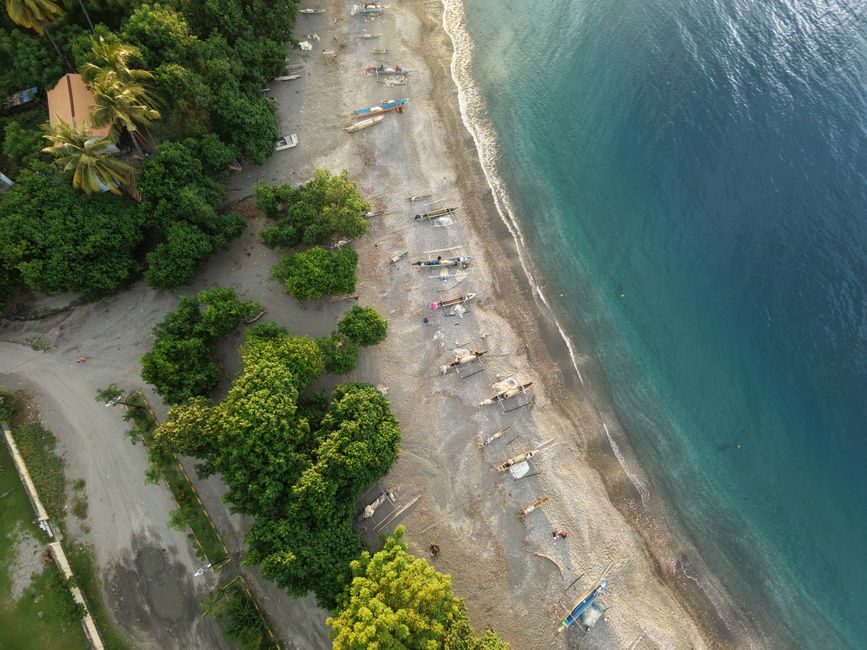
The second number is the flight. Dili’s Presidente Nicolau Lobato International Airport is served by a small handful of routes, and the fares reflect that scarcity. Return fares from Darwin, the shortest hop at roughly an hour and a half, run about $400 to $550 depending on how far ahead you commit. From Bali the flight is longer and often pricier, frequently $500 to $700 return. There is no budget carrier flooding this route with seats. The supply is thin and the prices sit where thin supply puts them.
What a Bed Costs
Dili accommodation splits into three tiers, and the gap between them is wide. Dorm beds in the handful of hostels and guesthouses cluster around $10 to $15 a night. A private room in a basic guesthouse runs $25 to $40. Mid-range hotels, the kind with reliable hot water and a generator for the frequent power cuts, sit at $60 to $90. The upmarket places on the waterfront, aimed at NGO staff and consultants on expense accounts, start around $150 and climb.
The NGO presence matters for pricing. Dili hosts a substantial international aid community, and that community anchors the top of the market. It also means mid-range rooms fill up during periods when organisations are running programmes or elections or both. Book ahead during those windows or pay for a tier above what you wanted.
Outside Dili the picture changes completely. Guesthouses in Baucau, the country’s second city, run $15 to $25 for a private room. In smaller towns like Same or Lospalos, $10 to $20 gets you a bed, sometimes with a shared bathroom and cold water only. At the guesthouses near Mount Ramelau, the country’s highest peak at 2,963 metres, expect $15 to $20 and bring a warm layer, because the elevation makes those nights genuinely cold by tropical standards.
Eating for $8 a Day
Food is where Timor-Leste rewards a tight budget. A plate of rice, beans and vegetables at a local eatery, a warung-style place with plastic chairs, costs $2 to $3. Grilled fish with rice runs $4 to $6. The national staple is a corn and bean stew, and it appears on most local menus for a few dollars.
Dili’s restaurant scene, concentrated around the beachfront and the streets behind it, prices higher. A main course at a sit-down restaurant with international dishes runs $8 to $15. A coffee at one of the cafes that serve locally grown beans costs $1.50 to $3. The coffee itself is worth the stop. Timor-Leste grows arabica in the highlands around Ermera, and the export crop is one of the country’s few significant earners.
A day of eating on the cheap, local breakfast, a warung lunch, a simple dinner, lands around $8 to $12. Add a restaurant meal and it climbs to $20 to $25. Bottled water is $0.50 to $1 in shops and double that in restaurants. Tap water is not drinkable.
Getting Between Places
Transport is the line item that surprises people. There are no trains. Long-distance buses, mostly minibuses known locally as mikrolets, connect Dili to district capitals. Dili to Baucau, roughly 120 kilometres on a road that is partly good and partly not, costs $5 to $7 and takes three to four hours. Dili to Same is $4 to $6. Dili to Lospalos, the long eastern run, is $10 to $12 and can eat most of a day.
The road east from Dili to Baucau is sealed and reasonable. Beyond that, surfaces degrade. Travel times given by anyone local should be treated as optimistic. A 100-kilometre stretch can take four hours or six depending on rain and roadworks.
For shorter hops within Dili, mikrolets cost $0.25 to $0.50 a ride. Taxis are $2 to $5 for most trips inside the city. Motorbike taxis, common and quick, run $1 to $3.
Car rental with a driver, which is how most visitors reach places off the bus routes, costs $50 to $80 a day. Self-drive rentals exist but are limited, and the roads plus the driving style make a driver the saner choice for anyone unfamiliar with the terrain.
The Split on Dili, and the Rest
The cost difference between the capital and everywhere else is the single most useful thing to know. In Dili, a mid-range day, private room, three meals with one at a restaurant, local transport, runs $50 to $70. In the districts, the same day costs $25 to $40.
A two-week trip covering Dili, Baucau, the central highlands and the east, staying in guesthouses and eating local, lands in the region of $600 to $900 on the ground, excluding flights. Add the $30 visa and the $400 to $700 return airfare and the whole thing sits between $1,030 and $1,630. That is not the cheapest two weeks in Southeast Asia. It is also not close to the most expensive.
The numbers reward anyone who moves slowly and eats where the menu is not in English. They punish anyone expecting Indonesian or Thai price levels. Timor-Leste is its own arithmetic.
Leave a Reply