Some links on this page are affiliate links. If you book or buy through them, we may earn a small commission at no extra cost to you. It never changes what we recommend — every price here is one we would pay ourselves.
Uzbekistan sits in the middle of a group of countries where the daily spend tends to land somewhere between $20 and $40, depending on how you eat and where you sleep.
What a Day Costs
Uzbekistan sits in the middle of a group of countries where the daily spend tends to land somewhere between $20 and $40, depending on how you eat and where you sleep. Travellers who mix it up — one local meal, one more Western-style meal — report spending around $20 a day. That figure covers food and probably a dorm bed, but not much else. The ceiling is higher if you want it to be.
The low end of that range exists because the local food is cheap. Plov, bread, tea, a few skewers. You can eat well for less than what a coffee costs in Lisbon. The high end exists because imported goods and hotel rooms aimed at tour groups are priced in a different currency, and they know it.
The shape of a day matters as much as the numbers. In Tashkent, Samarkand or Bukhara, the pattern that keeps costs down is the one locals follow: a late, heavy breakfast of bread and tea at the guesthouse, a proper lunch of plov around two in the afternoon, and then something light in the evening. Plov is cooked in the morning and sold until the pot scrapes empty, so the best plates are gone by early afternoon and the restaurants that serve it are often closed by dusk. That rhythm is not a budget trick invented for visitors; it is just how the day runs, and it happens to be the cheapest way to eat.
Eating and Drinking
Street meals in Western Europe run $6 to $15. Casual cafe meals there run $10 to $25. Uzbekistan undercuts both, and not by a small margin. The same $10 that gets you a sandwich in Berlin gets you a full meal here, with tea, and probably change.
Drinks follow the same logic. In Morocco, which is a useful comparison for anyone building a mental map of North Africa and Central Asia, the average drink costs $1 to $4. That covers Nous Nous coffee, mint tea, beer, or fresh juice. Uzbekistan’s numbers are not wildly different. Tea is cheap. Fresh juice is cheap. Anything imported is not.
The trick is not to eat Western every meal. Do that and you are paying European prices in a country where the local economy runs on something else entirely. One local meal, one Western meal, and the day stays near $20.
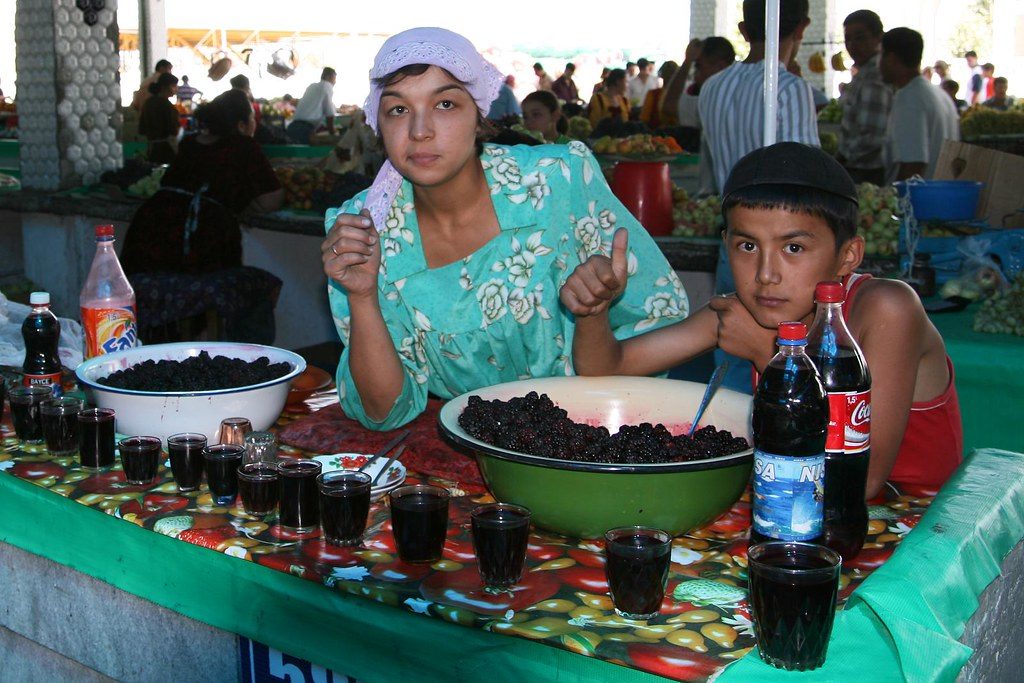
What actually goes wrong at mealtimes is rarely the price and usually the ordering. Menus in tourist districts are printed in three languages and the English column is the expensive one. The same dish, described only in Russian or Uzbek on a chalkboard around the corner, costs a fraction. Pointing at what the next table is eating works better than any phrasebook, and it is how most independent travellers end up with their best meal of the trip. Vegetarians have a harder time than the price list suggests: plov is built on meat and rice and the broth it cooks in, and asking for it without is often met with genuine confusion rather than refusal. The reliable fallbacks are the bread, the cucumber-and-tomato salads, the pumpkin samsas, and the noodle dishes that can be made plain.
Alcohol is where the budgeting gets uneven. Beer is widely available and cheap in the cities, less so in the conservative towns, and it is not sold openly during Ramadan in some neighbourhoods. Anything imported — a bottle of wine, a spirit from abroad — carries a markup that makes the local economy look like a different country. Tea is the default and the cheapest thing on any table, and it is refilled without being asked.
Sleeping
Bali used to have 15k meals and 50k-a-night accommodation. Those days are gone. The same shift has happened across a lot of Asia and it is happening in Central Asia too, though from a lower starting point.
There is a useful comparison from Japan, of all places. Business hotels there — Toyoko Inn at ¥5,500 to ¥8,000, Dormy Inn at ¥8,000 to ¥12,000 with free hot spring baths, APA Hotel at ¥6,000 to ¥10,000 — offer spotless private rooms at prices that would buy you a hostel bed in Europe. Converted, that is roughly $37 to $54 for Toyoko Inn, $54 to $81 for Dormy Inn, and $40 to $67 for APA. Uzbekistan does not have the same chain infrastructure, but the principle holds: paying for a private room does not automatically mean paying four times what a dorm costs.
Travelling as a pair changes the maths. A hotel room for two is generally cheaper than two beds in a hostel. That single fact reshapes a budget more than most people expect, because accommodation is the line item that eats the largest share.
The guesthouse model is what most of the country actually runs on. Family homes in Bukhara and Khiva have converted a wing into rooms around a courtyard, and the owner’s mother makes breakfast. These places are not listed on every booking site, and the ones that are tend to be the ones that have already raised their rates for foreign guests. Walking up and asking, or calling ahead, often lands a better room at a lower price than anything online. The trade-off is that English is thinner, the plumbing is what it is, and hot water may depend on the hour of the day. None of that is a surprise once it is expected.
Two things reliably go wrong with accommodation. First, the address. Street numbering in older districts is inconsistent and mapping apps drop pins in the wrong courtyard, so a host who offers to meet you at a landmark is offering something worth accepting. Second, registration. Hotels register foreign guests with the authorities as a matter of routine; smaller guesthouses sometimes do not, and the slip of paper matters at exit. It is worth asking directly whether the stay is being registered, and keeping every slip.
Visas and the Boring Extras
Some things cost nothing. Thailand’s 30-day visa exemption is free. Extending it by one month costs 1,900 baht, which is $62. That is the kind of number worth knowing before you arrive, because it is easy to assume a free entry means a free extension. It does not.
Insurance is the other line item people skip. Comprehensive travel insurance for a 10-day Europe trip runs $80 to $150 per person, depending on age, coverage level, and trip cost. Medical evacuation coverage matters especially for Americans, because US health insurance typically does not cover overseas emergencies. Uzbekistan is not Europe, but the principle is the same. A hospital bill without insurance is the fastest way to turn a $20-a-day trip into something else entirely.
The visa picture itself shifts often enough that the only reliable move is to check the official source close to departure rather than trusting a blog post, this one included. What does not shift is the small print around the edges: the ticket desk at a museum or a train station often closes mid-afternoon well before the site itself does, cash is expected in more places than cards are accepted, and the ATM that works in Tashkent may be the only one that works for a hundred miles. Carrying a modest amount of local currency solves more problems than any app.
On a first visit to a city, pre-booked entry removes one variable from the day.
The Realistic Number
If you eat one local meal and one Western meal, sleep in a dorm or a cheap private room, and do not book tours every day, $20 a day is achievable. If you want the private room, the occasional nicer dinner, and a guided trip somewhere, budget $40 to $50 and you will not feel pinched.
The Massai tribe visits in East Africa cost $40 to $100 per person depending on the length of the visit. That is a useful anchor for what a cultural excursion costs in a region where tourism is less developed. Uzbekistan’s equivalent — a day trip to a Silk Road site, a guided walk through a madrasa — sits in a similar band. Not free, not ruinous.
The mistake is treating any of these figures as fixed. They are guidelines. The actual number depends on how often you say yes to the thing that costs money and how often you say no.
Leave a Reply